DOBROMYL JEWISH HEADSTONE DATABASE
Stone ID:
N14A
Location:
Grounded/Loose:
grounded
Intact/Fragment:
Location X/Y:
Location GPS:
Material:
Color: grey Dimensions W H D, cm:
Inscription Style:
both incised and raised letter
Inscription Character Height, cm:
Name Original:
ישראל
Name English:
Yisrael
Name Ukrainian:
Ізраїль
Surname Original:
Surname English:
Surname Ukrainian:
Father Original:
ברוך אברהם
Father English:
Baruch Avraham
Father Ukrainian:
Барух Авраам
Husband Original:
Husband English:
Husband Ukrainian:
Gender:
male
Death Date Hebrew:
09-Shevat-5687
Death Date:
1927-01-12*
Age:
Birth Date:
Profession:
Primary Symbol:
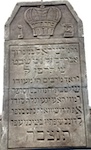
crown
Epitaph Original:
פ נ
ה'ה מ' ישראל ב'מ ברוך
אברהם ז'ל נ' ט' שבט
ש' תרפ'ז לפ'ק
ירא ד' מרבים הי' מעודו
שלם בתורתו חכם וסופר
רמזי הא'ע יגע וגלה סודו
את חידושיו אלה כתב בספר
לדובב שפתיו בשכני עפר
ת נ צ ב ה
Epitaph English:
here buried
the esteemed man [h] Yisrael son of [h] Baruch
Avraham, of blessed memory, died 9th Sh'vat
(in the) year (5)687 'by the small count'
God-fearing more than many [others] was he throughout his life
'immersed in Torah study', astute; an author,
he toiled over the cryptic hints of Ibn Ezra and unveiled his secret ─
these insights he wrote in a book
'to encourage the lips of those who dwell in the earth to murmur'
may his soul be bound in the bond of (eternal) life
the esteemed man [h] Yisrael son of [h] Baruch
Avraham, of blessed memory, died 9th Sh'vat
(in the) year (5)687 'by the small count'
God-fearing more than many [others] was he throughout his life
'immersed in Torah study', astute; an author,
he toiled over the cryptic hints of Ibn Ezra and unveiled his secret ─
these insights he wrote in a book
'to encourage the lips of those who dwell in the earth to murmur'
may his soul be bound in the bond of (eternal) life
Epitaph Ukrainian:
Acrostic Original:
ישראל
Acrostic English:
Yisrael
Additional Original:
Additional English:
Stone Condition:
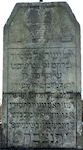
excellent, with only a single clean crack
Conservation:
Recovered from a walkway behind the house at vul. Adama Mitskevycha 8 in downtown Dobromyl in March 2016, then installed in a newly-constructed Wall of Memory at the Dobromyl Jewish cemetery in May and June 2016; see the web page About Dobromyl for more information.
ID Tag Poistion:
Recovery Date:
2016-03-12
Recovery GPS:
Other Notes:
[N] The crown incorporates an inscription כתר תורה, 'Crown of Torah'.
[N] His name Yisrael ישראל appears as an acrostic that spans lines 5-9, its letters significantly enlarged. As is often the case, the acrostic is accompanied by a rhyming feature – me'odo and sodo [lines 5 and 7]; ve'sofer, be'sefer, efer [lines 6, 8 and 9].
[N2] The abbreviation ה'ה may be interpreted as הוא היה 'he was' ─ when it acts as a conjunction on a gravestone between an initial laudatory section that is followed by genealogical information. However, placed here at the beginning of the epitaph, it abbreviates for האיש החשוב 'the esteemed man' or similar.
[N2-3] Is the father Rabbi Baruch Avraham of nearby Przemyśl? If so, he was the son of Rabbi Aharon Rokach of Dobromyl and Przemyśl, in turn the son of Rabbi Yehuda Zindel of Uchan, a son of the founder of the Belz dynasty, Rabbi Shalom.
[N4] The 3-letter abbreviation לפ'ק stands for לפרט קטן 'by the small count'. It often appears as a ligature, whereby these letters coalesce to form a single symbol. It confirms that the numeral 5 for 5000 is absent, it being obvious; a gravestone would have to predate the civil year 1239/40 for it to belong to the previous Jewish millennium.
[N5] Literally, the convoluted 'God-fearing of many was he since always'. ירא ד' מרבים appears exactly so in Nehemiah 7:2.
[N5] The literal 'God-fearing' is a translation that is widely-accepted, meaning 'devout'. 'God' is inscribed 'ד rather than 'ה, the standard abbreviation for Hashem השם [The Name]. Appearing only in writing, 'ד represents an even-higher level of 'distancing' than that provided by 'ה, but is nevertheless voiced 'Hashem'.
[N5] היה is slightly abbreviated to 'הי to avoid inscribing the divine name יה.
[N6] Literally שלם בתורתו – 'complete' or 'fulfilled' in his Torah. Hence translated as having been 'immersed in Torah study' ─ Torah in the wider sense of Jewish learning.
[N7] The abbreviation הא'ע is problematic. Probably האבן עזרא [The] Ibn Ezra ─ a famous 12th century writer, whose prodigious oeuvre [biblical commentary, philosophy, poetry, grammar, even mathematics and astrology] has attracted many rabbinic 'super-commentaries' in order to elucidate his often difficult to comprehend cryptic style.
[N9] Following-on from the previous line, is this the esoteric title of a super-commentary on Ibn Ezra? Or perhaps it simply echoes the similar phrase דּוֹבֵב שִׂפְתֵי יְשֵׁנִים 'causing the sleepers' lips to murmur' upon which Ibn Ezra comments [Song of Songs 7:10] and was therefore chosen by the author of the epitaph as being particularly appropriate for the deceased's gravestone?
See About Dobromyl for an index to headstone locations in the Wall of Memory.
Stone is recorded as Grounded because it is fixed in the Wall of Memory.
[N] His name Yisrael ישראל appears as an acrostic that spans lines 5-9, its letters significantly enlarged. As is often the case, the acrostic is accompanied by a rhyming feature – me'odo and sodo [lines 5 and 7]; ve'sofer, be'sefer, efer [lines 6, 8 and 9].
[N2] The abbreviation ה'ה may be interpreted as הוא היה 'he was' ─ when it acts as a conjunction on a gravestone between an initial laudatory section that is followed by genealogical information. However, placed here at the beginning of the epitaph, it abbreviates for האיש החשוב 'the esteemed man' or similar.
[N2-3] Is the father Rabbi Baruch Avraham of nearby Przemyśl? If so, he was the son of Rabbi Aharon Rokach of Dobromyl and Przemyśl, in turn the son of Rabbi Yehuda Zindel of Uchan, a son of the founder of the Belz dynasty, Rabbi Shalom.
[N4] The 3-letter abbreviation לפ'ק stands for לפרט קטן 'by the small count'. It often appears as a ligature, whereby these letters coalesce to form a single symbol. It confirms that the numeral 5 for 5000 is absent, it being obvious; a gravestone would have to predate the civil year 1239/40 for it to belong to the previous Jewish millennium.
[N5] Literally, the convoluted 'God-fearing of many was he since always'. ירא ד' מרבים appears exactly so in Nehemiah 7:2.
[N5] The literal 'God-fearing' is a translation that is widely-accepted, meaning 'devout'. 'God' is inscribed 'ד rather than 'ה, the standard abbreviation for Hashem השם [The Name]. Appearing only in writing, 'ד represents an even-higher level of 'distancing' than that provided by 'ה, but is nevertheless voiced 'Hashem'.
[N5] היה is slightly abbreviated to 'הי to avoid inscribing the divine name יה.
[N6] Literally שלם בתורתו – 'complete' or 'fulfilled' in his Torah. Hence translated as having been 'immersed in Torah study' ─ Torah in the wider sense of Jewish learning.
[N7] The abbreviation הא'ע is problematic. Probably האבן עזרא [The] Ibn Ezra ─ a famous 12th century writer, whose prodigious oeuvre [biblical commentary, philosophy, poetry, grammar, even mathematics and astrology] has attracted many rabbinic 'super-commentaries' in order to elucidate his often difficult to comprehend cryptic style.
[N9] Following-on from the previous line, is this the esoteric title of a super-commentary on Ibn Ezra? Or perhaps it simply echoes the similar phrase דּוֹבֵב שִׂפְתֵי יְשֵׁנִים 'causing the sleepers' lips to murmur' upon which Ibn Ezra comments [Song of Songs 7:10] and was therefore chosen by the author of the epitaph as being particularly appropriate for the deceased's gravestone?
See About Dobromyl for an index to headstone locations in the Wall of Memory.
Stone is recorded as Grounded because it is fixed in the Wall of Memory.
Last Revision:
2024-04-28
Image Gallery: